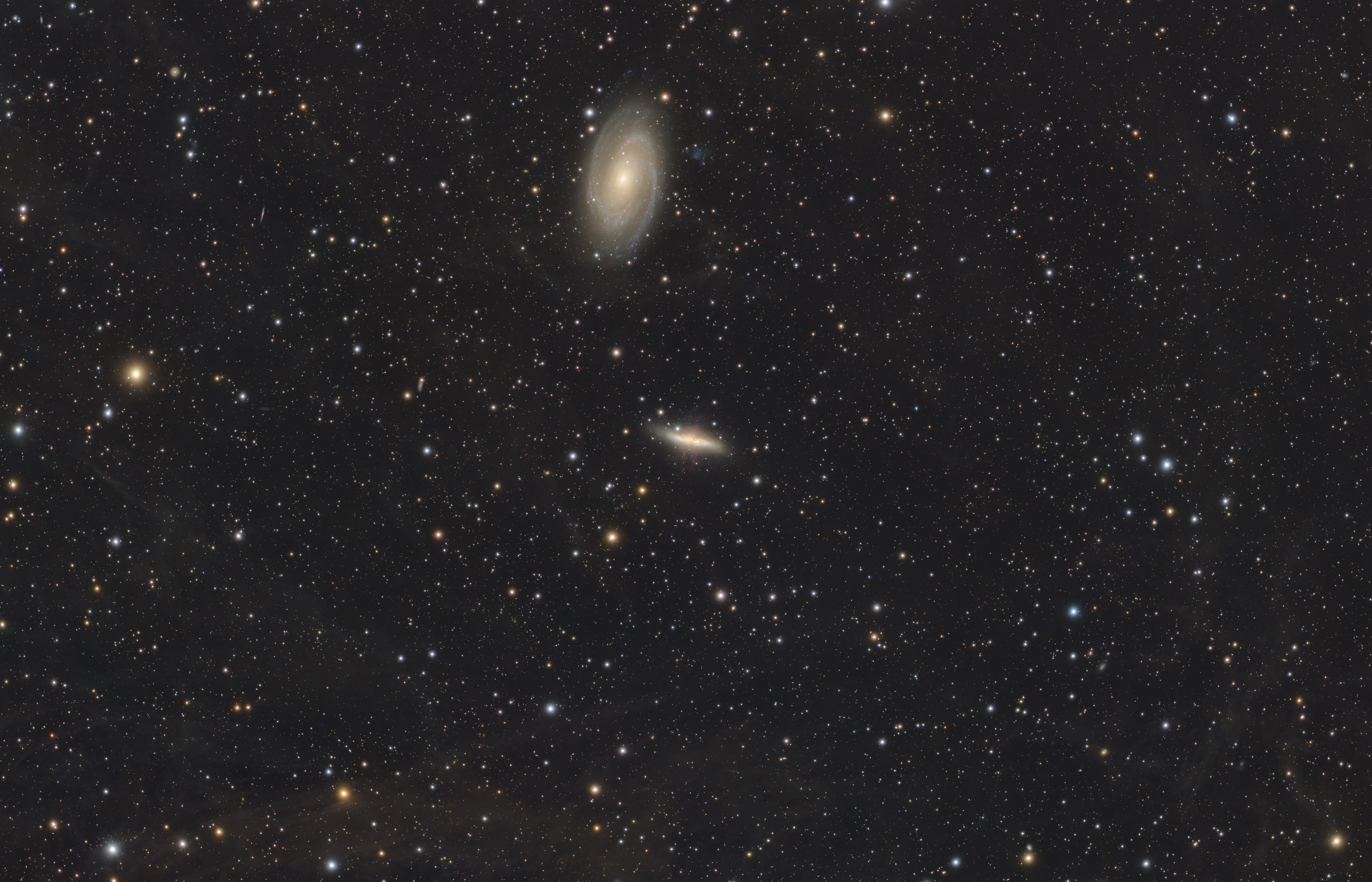
This is the second image I have captured and processed, and it is the one I am happiest with so far. What keeps pulling me back to this field is the contrast between the pair: M81 is a textbook spiral, quiet and composed, while M82 looks torn open by the gravitational interaction between the two. Even at this scale, they feel like they belong together while refusing to look anything alike.
Setup and Acquisition
I shot this from a borrowed backyard in Troy, Idaho (Bortle 4) over three nights — two in January 2026 and one in March 2026. The total integration time came to a little over twenty-one hours, all one-shot color with no filters. Night one was rough: 160 frames collected, most of them discarded. Nights two and three were considerably cleaner.
- Telescope: Askar SQA85
- Camera: ZWO ASI2600MC Pro (imaging), ZWO ASI220MM Mini (guiding)
- Mount: Sky-Watcher EQ6-R Pro
- Accessories: ZWO ASIAIR Pro, Jackery Explorer 300
- Processing: PixInsight, BlurXTerminator, NoiseXTerminator, GraXpert
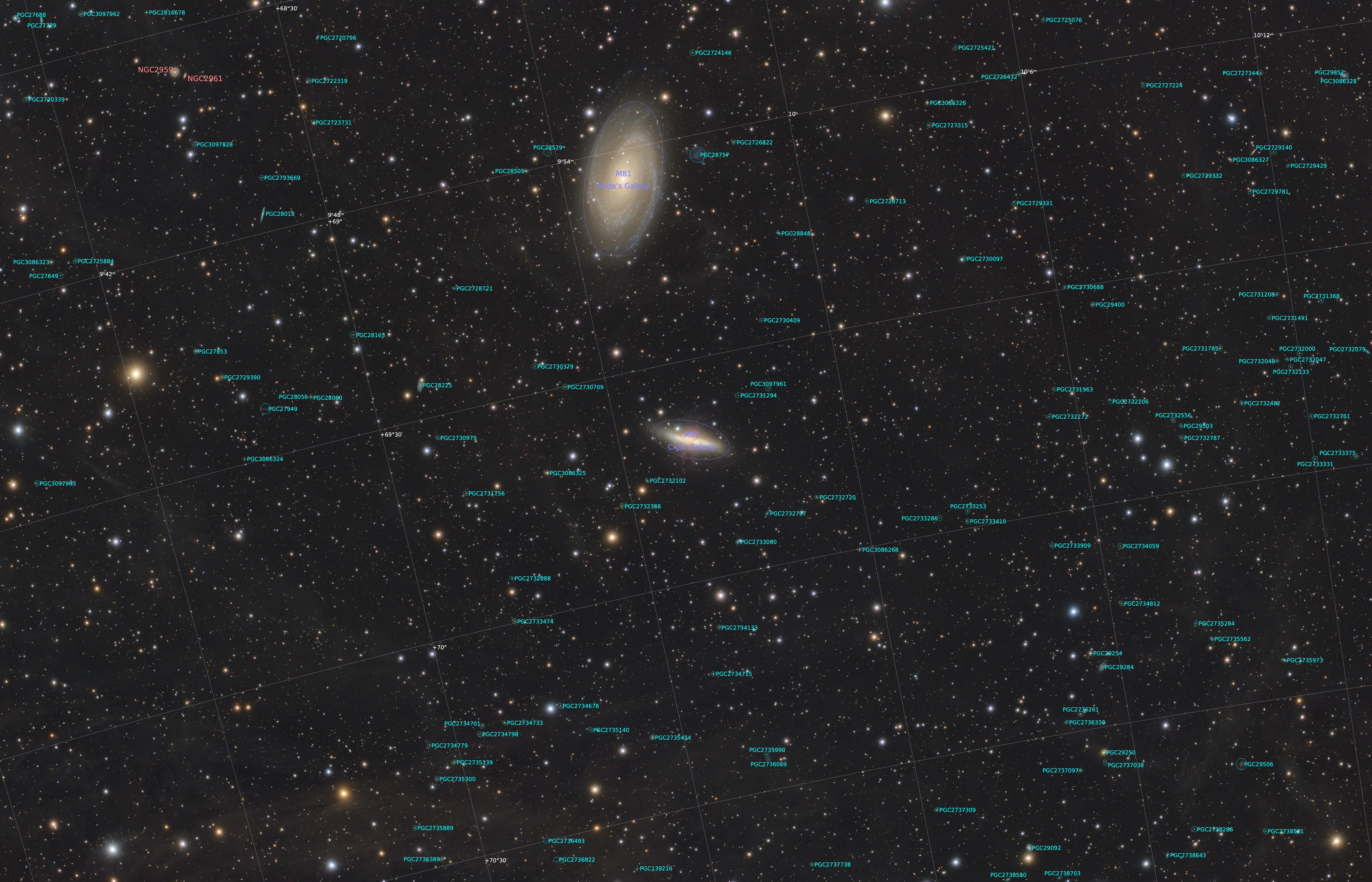
The field of view ended up at roughly 3° × 2° at 1.9 arcseconds per pixel: wide enough to catch M81 and M82 together with some of the surrounding IFN, but not quite wide enough to give NGC 3077 the room it deserved.
Framing
To be honest, this framing was mostly accidental. At that point I was still happy just to have everything working at all. Once the pair drifted into view, I called it good enough and started collecting data. In hindsight, centering M81 a bit more deliberately would have given NGC 3077 better breathing room in the lower part of the frame.
What I Would Still Change
- I would like a cleaner transition through the brightest core of M81. The HDR processing still feels a little abrupt.
- As always: more integration time, steadier seeing, and cleaner skies.